
It’s important to have a strategy to evolve your printing as your business grows. Customers are continuously challenging your capabilities, and you want to remain competitive. This is a path to addressing business concerns. Often, gains can be realized with simple updates to your current equipment. There are three key points to consider: throughput, space, and quality.
When evaluating your current plateroom throughput, one essential consideration should be whether there are alternate formats that could lead to gains that maximize output and minimize waste. Often, printers quickly outgrow equipment capabilities, so it's important to include growth strategies in this conversation. New press acquisitions often lead to more complex print challenges and increased volumes, making it essential to reconfigure the plateroom so it does not become a bottleneck to production efficiencies.
If you already have equipment or are evaluating a specific format size, it is easy to calculate whether this will be a good format for you in the future.
Take your most common job repeat size and determine how many separations (plates) you can get on a full sheet of photopolymer based on the plate format size you are evaluating. It is also important to perform this same calculation for your maximum size plates. Include any margins you use for plate handling (i.e., a 0.5" border around the image area for handling).
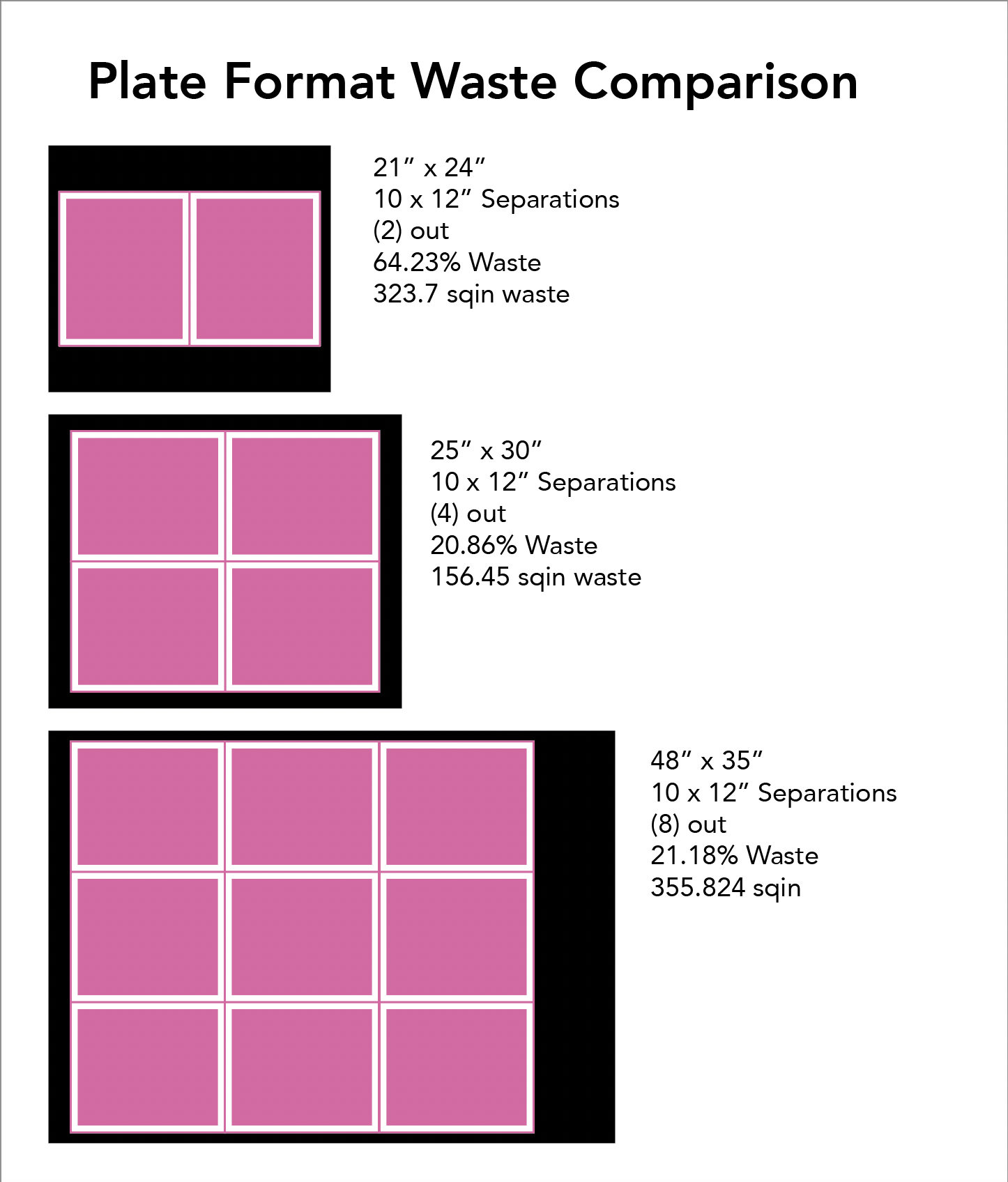
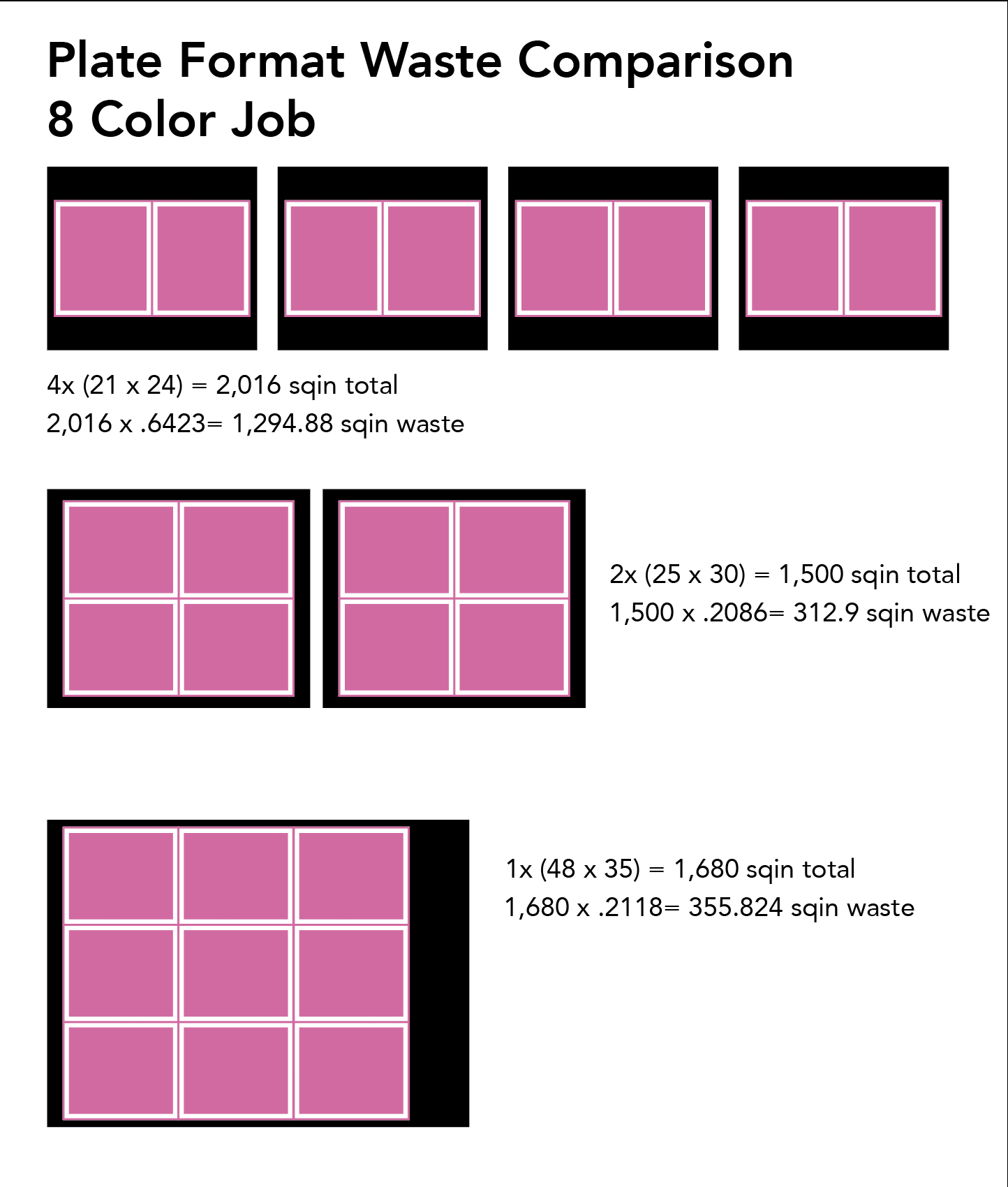
As an example, a 10" x 12" plate with a 0.5" border will yield 2 separations out on a 24" x 20" plate format but will get 4 separations out on a 25 x 30" plate format. Comparatively, every time you would process a plate on 24 x 20, you'd waste approximately 37.59% of your plate vs approximately 20.86% with a 25 x 30" plate system. You can take this one step further and calculate the cost of this waste by calculating the cost of a sheet, multiplying it by the waste percentage, and adding up all the sheets you make in a year.
Another consideration for throughput is determining where bottlenecks exist in your workflow. Some common contributors are imaging, processing, and drying time (if you're making solvent plates). If you upgrade your imaging capabilities, you can try to match the imaging speed to the processing speed to reduce downtime between moving plates. Plate drying time is a necessary evil as it stabilizes the plate so that it prints properly.
The next point of consideration is space. It is important to consider the space your operators will need to move to run the equipment, access internal components for maintenance, and proximity of the machine to the utility hookups. Your plate supplier can assist you with playroom layouts and specifications. If you currently have equipment, consider auditing how the operators move the plate around and where improvements could be made. Learning how the plate can and should move through the space will help reduce errors and defects on the plate.
The last key point to consider is quality. Namely, it is important to match your plateroom capability with your artwork requirements. This can include resolution, surface screening, highlight screening, or dot structure. Will you need to match legacy files or work from another location? There is no universal right answer; the measure of success depends on you and your customers' expectations.