
APR’s FlexoAcademy Builds Momentum at Toppan as Blended Training Program Expands Across Production and Support Teams
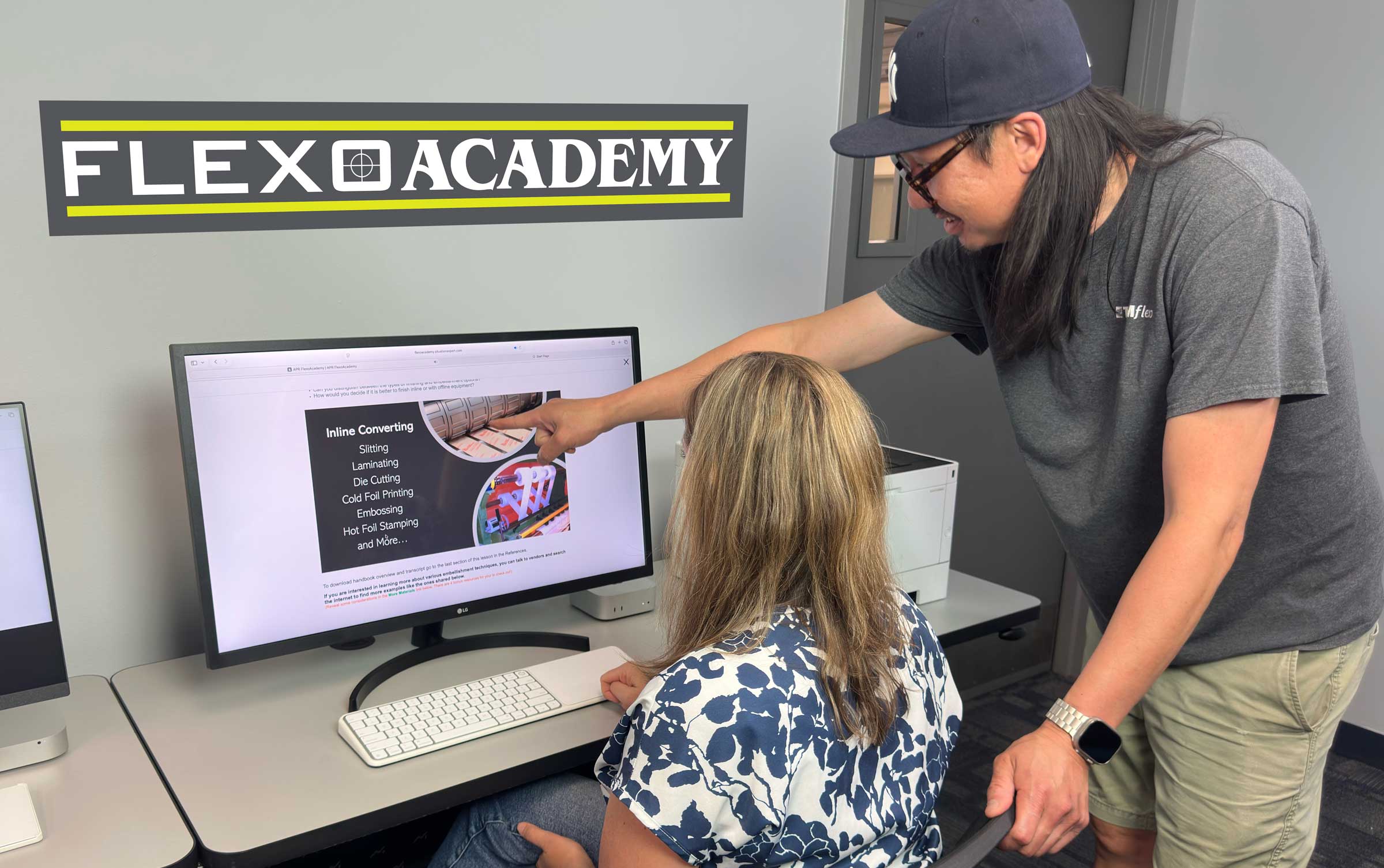
For flexible packaging converters, workforce development has become more than an HR priority. It is now a production issue, a quality issue, and a long-term competitiveness issue. At Toppan, formerly Sonoco, in Hickory, North Carolina, the challenge was not a lack of training commitment. The company already had a structured, hands-on training program led by industry veteran David Wheatley, Press Trainer at Toppan. The challenge was finding a way to make training more consistent, more scalable, and less dependent on pulling key personnel away from the production floor.
Toppan’s Hickory facility produces a diverse mix of flexible packaging, serving markets that include the food and tobacco industries. The company’s print technology includes four central impression flexo presses, supporting work that ranges from paper-based snack container wraps to film structures for pouches, bags, and other flexible packaging formats.
Wheatley, who started with the company 14 years ago as a press assistant before becoming a press operator and then press trainer, stresses that training is essential, but the pressroom cannot stop while that training happens. He comments, “One of the primary issues I’ve always had is having enough manpower so that the press can continue to run efficiently while I’m trying to train someone. Ultimately, I’m left with making sure that person is trained, but at the same time, I have to keep the press running efficiently without sacrificing production. That has always been my biggest challenge.”
To support that effort, Toppan turned to APR’s FlexoAcademy, a blended training platform designed to combine self-paced online learning, instructor-led sessions, interactive exercises, and real-world flexographic fundamentals. For Toppan, FlexoAcademy served as a structured extension of its internal training program, giving employees a shared knowledge foundation before Wheatley moved them into equipment- and process-specific instruction.
According to Catherine Haynes, Executive Vice President at APR, Toppan’s program implementation began with an onsite training assessment in 2024. From there, APR worked with Wheatley and the company’s leadership team to formalize a structure that would complement the training already taking place on the production floor.
“David had already built a thoughtful, well-structured training approach for his team,” said Haynes. “Our goal was to help him expand that foundation with a blended FlexoAcademy program that could bring new and experienced employees to a common baseline of knowledge. By pairing onsite instruction with online Flexo Fundamentals content, the Toppan team could engage with the material in a more consistent way, while David could focus his time on the specific equipment, processes, and production realities unique to their facility.”
The first group, which included 10 production personnel, began training in February 2025. The program started with a one-day onsite introductory session. Participants then had approximately eight weeks to complete FlexoAcademy’s On-Demand Flexo Fundamentals content, with APR periodically checking in to support progress. The group later reconvened for a one-day onsite Advanced Flexo training session.
For Wheatley, one of FlexoAcademy’s greatest strengths was the way it connected the flexographic process from end to end. While he already had a strong system for training press personnel, the program helped organize key concepts in a way that made the full production workflow easier to understand. “Catherine did a really good job of laying it out, from prepress and graphics through the press department and into the next steps in production,” he explained. “I heard a lot of my people say, ‘Well, that makes sense now.’ I may have touched on some of those topics before, but not always in the right order. When it’s presented in a clear flow, it’s easier for people to understand how everything connects.”
That sequential understanding proved especially valuable in helping employees connect upstream decisions to downstream results. Wheatley says several participants gained a clearer understanding of how prepress choices affect what happens on press. “A number of people said they didn’t realize that if something doesn’t get done correctly in prepress, it’s going to affect us downstream. It’s going to hit the pressroom and limit what our capabilities are. That was very beneficial.”
The program also created value beyond the pressroom. Toppan’s quality manager and pressroom supervisor, both newer to the flexographic print process, participated in the training and found it immediately useful. According to Wheatley, the quality manager gained so much from the experience that he is now interested in putting additional quality technicians through the program. Toppan is also considering FlexoAcademy for other support roles, including graphics and prepress personnel who interact with production but may not fully understand what happens on the press.
Another feature of FlexoAcademy that resonated with Toppan was the use of virtual press simulation. For employees who may never operate a press, the simulator provided a low-risk way to see how press components interact and how certain decisions affect print outcomes. FlexoAcademy also delivered practical technical value for experienced personnel. Wheatley points specifically to the color theory section, which helped both newer and more seasoned employees think differently about how color is measured and controlled. “Catherine did a great section on color theory, and it opened a lot of people’s eyes. Some people had been running press for a couple of years and had never really thought about what we’re looking at and how we measure color. I learned some things from that as well.”
For APR, Toppan’s experience reflects the larger purpose of FlexoAcademy: helping converters build stronger training systems at a time when skilled labor remains difficult to find, retain, and develop. “The success at Toppan shows what can happen when a company combines internal expertise with a structured, flexible learning platform,” said Haynes. “FlexoAcademy is not a one-size-fits-all program. It is designed to support the way converters actually train, with a balance of online learning, instructor engagement, discussion, and practical application. At Toppan, that blended model turned training into a more structured, repeatable process, helping the company build flexo knowledge across the organization while reinforcing its investment in its people.”